
Douglas Adams Books in Order
See Douglas Adams books in order, from Hitchhiker's and Dirk Gently to nonfiction, with brief summaries, series background and simple tips on where new readers should start.
Last updated:
As an Amazon Associate, we earn from qualifying purchases (at no extra cost to you).
Douglas Adams books in publication order
21 books
The Hitchhiker's Guide to the Galaxy
by Douglas Adams
1979
Seconds before Earth is demolished to make way for a hyperspace bypass, bewildered everyman Arthur Dent is whisked into deep space by his friend Ford Prefect and the starship Heart of Gold, stumbling into a funny tour of an indifferent universe.
Recommended by
10 people Elon Musk recommended this book
Elon Musk
"A book of philosophy disguised as a silly humor book." - Elon Musk
Elon Musk's recommendation of this book  Shah Rukh Khan recommended this book
Shah Rukh Khan
"I looked forward to books by [this author] when he was alive." - Shah Rukh Khan
Shah Rukh Khan's recommendation of this book  Naval Ravikant recommended this book
Naval Ravikant
"Classic. I love [this book]." - Naval Ravikant
Naval Ravikant's recommendation of this book  Seth Rogen recommended this book
Seth Rogen
"I love [this book]." - Seth Rogen
Seth Rogen's recommendation of this book  Richard Branson recommended this book
Richard Branson
Richard Branson recommended this book on his "70 must-read books" blog post.
Richard Branson's recommendation of this book  Tim Ferriss recommended this book
Tim Ferriss
"If 'Fear and Loathing in Las Vegas' and 'Star Wars' had a love-child, it would read something like this." - Tim Ferriss
Tim Ferriss's recommendation of this book +4
More recommendations
- Evan Goldberg
Evan Goldberg mentioned this book on "The Tim Ferriss Show" podcast.
- Sahil Lavingia
Sahil Lavingia recommended this book on Notion.
- Jack Edwards
"A bit silly but also good fun to read." - Jack Edwards
- Zack D'Aleo
"SciFi umoristico. Inchini ad Adams il sommo re del no sense." - Zac D'Aleo
- Evan Goldberg
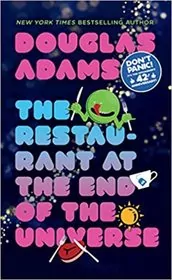
The Restaurant at the End of the Universe
by Douglas Adams
1980
After barely escaping a Vogon attack, Arthur, Ford, Zaphod and Trillian ride the Heart of Gold to Milliways, a restaurant built inside a time bubble at the universe's end, where interstellar politics, impossible coincidences and very bad decisions collide.
Not 1982
by Douglas Adams
1981
This spoof annual tied to the sketch show Not the Nine O'Clock News crams each page with parody features, fake news and quirky snippets, including early versions of Adams's comic dictionary ideas that later grew into The Meaning of Liff.
Life, the Universe and Everything
by Douglas Adams
1982
Summoned from a sleepy exile, Arthur and Ford join Slartibartfast, Trillian and Zaphod to stop the fanatical robots of Krikkit from wiping out the rest of the galaxy, in a chaos filled mix of cricket jokes, time travel and cosmic sabotage.
The Meaning of Liff
by Douglas Adams
1983
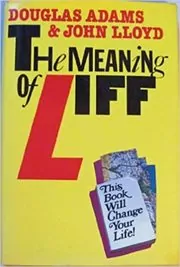
In this comic dictionary created with John Lloyd, Adams raids real place names and reassigns them as words for everyday feelings, frustrations and social mishaps, turning road signs and map labels into a running joke about how language really works.
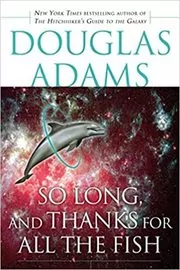
So Long, and Thanks for All the Fish
by Douglas Adams
1984
Arthur Dent returns to a mysteriously restored Earth, falls in love with the elusive Fenchurch and tries to make sense of vanished dolphins, strange memories and God's final message, in a more romantic, earthbound but still very odd Hitchhiker adventure.
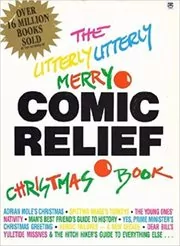
The Utterly Utterly Merry Comic Relief Christmas Book
by Douglas Adams
1986
Edited by Douglas Adams for charity, this collection gathers irreverent Christmas pieces, TV tie ins and sketches from leading British comedians, including rare Adams stories and Hitchhiker fragments, all produced to raise money for Comic Relief.
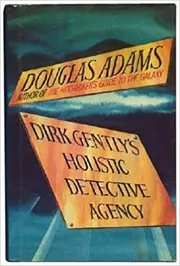
Dirk Gently's Holistic Detective Agency
by Douglas Adams
1987
Meet Dirk Gently, a shambling, debt ridden private detective who believes in the fundamental interconnectedness of everything and tackles a case that mixes missing cats, ghosts, ancient aliens, time travel and a Cambridge college dinner gone very wrong.
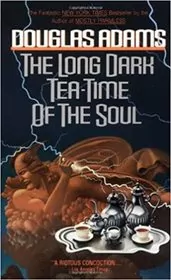
The Long Dark Tea-Time of the Soul
by Douglas Adams
1988
Dirk Gently stumbles into an explosion at Heathrow Airport and a string of impossible deaths that turn out to involve bored Norse gods, record contracts and a mysterious clinic, in a darker but still absurd mystery set in contemporary London.
Last Chance to See
by Douglas Adams
1990
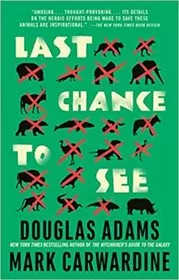
Part travelogue, part conservation plea, this nonfiction journey follows Douglas Adams and zoologist Mark Carwardine as they cross the globe seeking endangered animals, blending sharp humor with sobering glimpses of kakapos, Komodo dragons, rhinos and other species on the brink.
Recommended by
1 person Patrick O'Shaughnessy recommended this book
Patrick O'Shaughnessy
"The funniest travel book I’ve ever read." - Patrick O'Shaughnessy
Patrick O'Shaughnessy's recommendation of this book
The Deeper Meaning of Liff
by Douglas Adams
1990
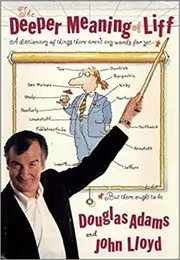
This follow up to The Meaning of Liff expands Adams and John Lloyd's joke dictionary with even more place name based words, offering a fresh batch of silly yet accurate labels for oddly specific situations English never quite named.
Mostly Harmless
by Douglas Adams
1992
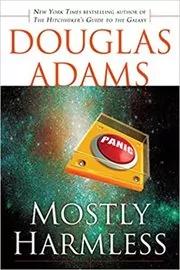
Arthur Dent washes up on a backwater planet and tries to build a quiet life, just as his old friends, his reporter ex Tricia and their unpredictable daughter Random are drawn into a last, bleaker twist in the Guide's story.
Live in Concert
by Douglas Adams
1994
Recorded at London's Almeida Theatre in 1995, this live performance captures Douglas Adams reading and acting out favorite passages from The Hitchhiker's Guide to the Galaxy and its sequels, complete with asides, timing and audience laughter you can hear.
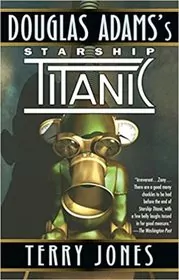
Starship Titanic
by Douglas Adams
1997
Based on Douglas Adams's concept for a luxury starliner that suffers a spontaneous massive existence failure, this comic novel follows three humans swept aboard the malfunctioning Starship Titanic as they battle eccentric robots, bureaucratic chaos and an insurance scam.
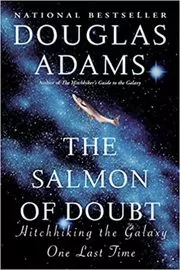
The Salmon of Doubt
by Douglas Adams
2002
A posthumous collection of Douglas Adams's essays, interviews and fiction, this volume ranges from technology and atheism to travel and conservation, and includes the witty, unfinished Dirk Gently novel that was still on his screen when he died.
Recommended by
1 person- Naval Ravikant recommended this book
Naval Ravikant
"Recommended." - Naval Ravikant
Naval Ravikant's recommendation of this book
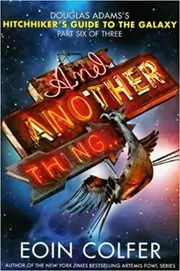
And Another Thing...
by Douglas Adams
2009
Written by Eoin Colfer from Douglas Adams's notes, this sixth Hitchhiker novel picks up after Mostly Harmless as Arthur, Ford, Trillian and Random face yet another threat of annihilation, runaway bureaucracy, bored gods and the eternally insult hurling Wowbagger.
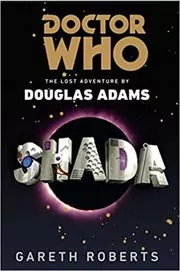
Shada
by Douglas Adams
2012
Adapted from Douglas Adams's unfilmed Doctor Who script, this novel sends the Fourth Doctor and Romana back to Cambridge, where an absent minded professor, a mysterious book and a hidden Time Lord prison draw them into a chase across space and time.

Doctor Who and The Pirate Planet
by Douglas Adams
2017
Based on Douglas Adams's Key to Time adventure, this novel has the Doctor, Romana and K 9 arriving on the mysterious world of Zanak, whose brutal, bombastic Captain hides a planet sized secret that threatens worlds far beyond the target of their quest.
Secondary Phase
by Douglas Adams
2018
This remastered audio set presents the second Hitchhiker's radio series, following Arthur and Ford as they try to escape prehistoric Earth while Zaphod is dragged to Frogstar, faces the Total Perspective Vortex, and discovers who might really run the universe.

Doctor Who and the Krikkitmen
by Douglas Adams
2019
Drawn to what looks like an ordinary cricket match, the Doctor and Romana are swept into a revived war with the ruthless Krikkitmen, racing across worlds to keep a scattered cosmic key from freeing an imprisoned planet bent on destroying the universe.
42: The Wildly Improbable Ideas of Douglas Adams
by Douglas Adams
2023
An illustrated tour through Douglas Adams's archive, this large format book reproduces notebooks, drafts, letters, scripts and speeches, tracing his ideas from school days and early collaborations to Hitchhiker's, Dirk Gently, Doctor Who, Last Chance to See and digital experiments.
Where to start with Douglas Adams
If you want classic comic space adventure: The Hitchhiker's Guide to the Galaxy → The Restaurant at the End of the Universe → Life, the Universe and Everything
If you prefer a smaller scale, mystery driven story: Dirk Gently's Holistic Detective Agency → The Long Dark Tea-Time of the Soul
If you want nonfiction with the same sense of humor: Last Chance to See → The Salmon of Doubt
If you love language and wordplay: The Meaning of Liff → The Deeper Meaning of Liff
If you are curious about everything at once: The Hitchhiker's Guide to the Galaxy → Last Chance to See → 42: The Wildly Improbable Ideas of Douglas Adams
Douglas Adams sub-series and character series
Hitchhiker's Guide to the Galaxy books in order
Explore this series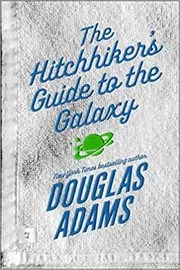
The Restaurant at the End of the Universe
by Douglas Adams
1980Hitchhiker's Guide to the Galaxy, Book 2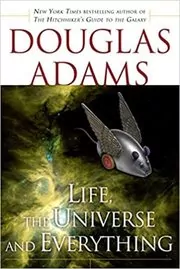


Hitchhiker's Guide to the Galaxy books in chronological order
The Restaurant at the End of the Universe
by Douglas Adams
1980Hitchhiker's Guide to the Galaxy, Book 2
Douglas Adams collections, short stories, and related book types
Non-Fiction

by Douglas Adams
1990A Dictionary of Things There Aren't Any Words for Yet--But There Ought to Be
Standalone Douglas Adams books
Author bio
Douglas Adams was born in Cambridge, England in 1952 and spent his childhood moving between the city, the East End of London and the town of Brentwood in Essex after his parents separated. Those early years mixed upheaval with a lot of reading, school essays and joke pieces that teachers noticed enough to encourage.
At Brentwood School he began to treat writing as something more than homework, selling jokes to classmates and trying out ideas in school magazines. By the time he went up to St John's College, Cambridge to study English, he already knew he wanted to write but was not yet sure how to make that a life. University gave him stages as well as classrooms, and he gravitated toward performance as much as prose.
In Cambridge he became associated with the Footlights club, a training ground for several generations of British comedy writers and performers. Adams was not the most natural actor in the room, but he had an ear for dialogue and a feel for how surreal ideas could be made to sound oddly reasonable. Those student shows, half chaos and half discipline, gave him his first sense of how to shape sketches for an audience instead of just for the page.
After graduating he moved to London and went through a stretch of odd jobs and near misses. He worked as a hospital porter, a bodyguard and even a chicken shed cleaner between short spurts of paid comedy writing. A chance meeting with Graham Chapman of Monty Python led to a brief partnership and a couple of credits on late Python material and other sketch projects. The work was exciting, but it was never quite enough to pay the bills, and he spent several years on the edge of leaving writing behind.
Radio turned out to be the place where everything finally clicked. In the late 1970s he pitched a science fiction comedy for BBC radio that would become The Hitchhiker's Guide to the Galaxy. The first series aired in 1978, using stereo sound, odd music cues and a deadpan narrator to follow bewildered earthling Arthur Dent after the destruction of Earth. It built a cult audience almost immediately and gave Adams another job at the BBC as a script editor and writer for Doctor Who, where he worked on stories such as The Pirate Planet and the uncompleted Shada.
Adams turned the radio scripts into novels, beginning with The Hitchhiker's Guide to the Galaxy and continuing through The Restaurant at the End of the Universe, Life, the Universe and Everything, So Long, and Thanks for All the Fish and Mostly Harmless. What started as a single book evolved into a self-mocking "trilogy in five parts" that bounced between galaxies, timelines and alternative Earths while circling questions about meaning, bureaucracy and how small human worries survive in a vast universe.
He did not want to be defined by one series. In the late 1980s Adams launched the Dirk Gently books, beginning with Dirk Gently's Holistic Detective Agency and The Long Dark Tea-Time of the Soul, which mashed up ghost stories, time travel, Norse gods and the detective genre. Around the same time he collaborated with producer John Lloyd on The Meaning of Liff and The Deeper Meaning of Liff, comedy dictionaries that recycle place names as labels for everyday feelings that English never quite named.
Outside fiction, Adams poured his energy into environmental work and travel. With zoologist Mark Carwardine he created Last Chance to See, first a radio series and then a book, following endangered animals such as kakapos, Komodo dragons and river dolphins. The journeys are funny on the surface, but the punch line is usually that a species is hanging on by a thread, and Adams often said it was the project he was proudest of.
He was equally fascinated by technology. Adams bought early personal computers, fell hard for the first generation of Macintosh machines and wrote enthusiastic pieces about email, online communities and the possibilities of networked information long before they were mainstream. Late in his career he helped create a collaborative online guide inspired by the fictional Guide, and the posthumous collection The Salmon of Doubt and the archive volume 42 preserve memos and talks in which he sketched out ideas that look a lot like smartphones and ebooks.
Adams died suddenly of a heart attack in Santa Barbara, California, in May 2001 while training at a gym, aged 49. He left behind unfinished drafts, piles of notebooks and a set of stories that kept mutating across radio, books, television, stage and games. What continues to draw readers in is not just the jokes, but the way he let ordinary annoyance and wonder sit side by side with planets, gods and the number 42.


Edited by
Software engineer whose passion for tracking book recommendations from podcasts inspired the creation of MRB.
Lead investor at 3one4 Capital whose startup expertise and love for books helped shape MRB and its growth.
Comments
Did we miss something? Have feedback?
Help us improve this page by sharing your thoughts