
Carl Sagan Books in Order
Browse Carl Sagan’s books in order, with quick summaries, themes, and suggestions on where to start, plus background on his life, science writing, and legacy.
Last updated:
As an Amazon Associate, we earn from qualifying purchases (at no extra cost to you).
Carl Sagan books in publication order
17 books
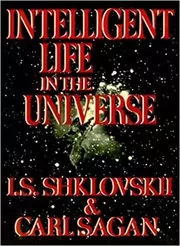
Intelligent Life in the Universe
by Carl Sagan
1966
Coauthored with astronomer I. S. Shklovskii, Intelligent Life in the Universe surveys what science can say about life beyond Earth. Drawing on astronomy, biology, and early spaceflight, it examines how civilizations might arise and what contact between species could look like.

Planets
by Carl Sagan
1966
Planets offers an illustrated introduction to our solar system, written near the dawn of the space age. Sagan explains what telescopes and early spacecraft revealed about the surfaces, atmospheres, and histories of the worlds orbiting our Sun.
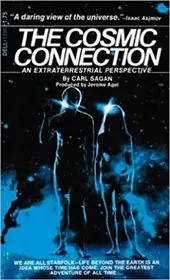
The Cosmic Connection
by Carl Sagan
1973
The Cosmic Connection collects essays that link everyday life on Earth to the wider universe. Sagan writes about planetary exploration, the search for extraterrestrial intelligence, and humanity’s long fascination with the stars, arguing that our future is bound up with the cosmos around us.
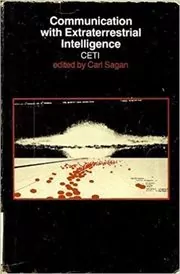
Communication with Extraterrestrial Intelligence
by Carl Sagan
1974
Communication with Extraterrestrial Intelligence gathers essays from scientists and thinkers on how we might talk with alien civilizations. Topics range from radio astronomy and message design to mathematics, language, and the cultural shock of learning that we are not alone.
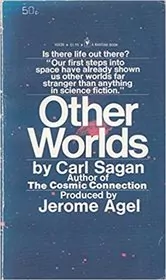
Other Worlds
by Carl Sagan
1975
Other Worlds traces changing ideas about planets and moons, from ancient myths and telescopic illusions to spacecraft images. Sagan looks closely at Mars, Venus, and the outer planets, asking what makes a world habitable and how we imagine life elsewhere.
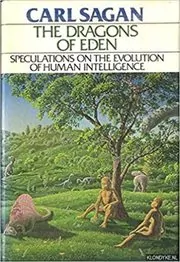
The Dragons of Eden
by Carl Sagan
1977
The Dragons of Eden explores how human intelligence evolved, weaving together astronomy, biology, anthropology, and computer science. Sagan looks at brains from reptiles to primates and reflects on what our mental history suggests about dreams, language, and the future of our species.
Recommended by
1 person Patrick O'Shaughnessy recommended this book
Patrick O'Shaughnessy
"I love to read about human evolution because it reminds me how slow our biology changes." - Patrick O'Shaughnessy
Patrick O'Shaughnessy's recommendation of this book
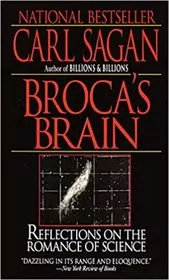
Broca's Brain
by Carl Sagan
1979
Broca’s Brain is a collection of essays on science, pseudoscience, and the human mind. Sparked by Sagan’s visit to the preserved brain of neurologist Paul Broca, it ranges from relativity and time travel to astrology, UFOs, and what counts as good evidence.
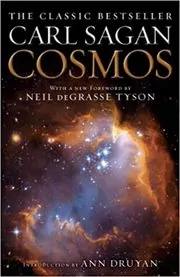
Cosmos
by Carl Sagan
1980
Cosmos takes readers from the birth of stars and planets to the rise of life on Earth. Sagan blends astronomy, history, and philosophy into an accessible story about how we came to understand the universe and our small place within it.
Recommended by
2 people Richard Branson recommended this book
Richard Branson
Richard Branson recommended this book on his "70 must-read books" blog post.
Richard Branson's recommendation of this book  Bill Nye recommended this book
Bill Nye
"The story of my other hero, Carl Sagan. The other guy who inspired me to do what I do now." - Bill Nye
Bill Nye's recommendation of this book
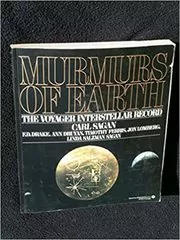
Murmurs of Earth
by Carl Sagan
1983
Murmurs of Earth tells the inside story of the Voyager Golden Record, the message launched into interstellar space aboard the Voyager probes. Sagan and his colleagues describe how they chose the sounds, images, and music meant to introduce humanity to distant beings.

The Cold and the Dark
by Carl Sagan
1984
The Cold and the Dark examines the possible global aftermath of nuclear war, especially the “nuclear winter” scenario. Sagan and his coauthors synthesize climate models, biology, and history to show how firestorms and dust clouds could devastate ecosystems and human society.
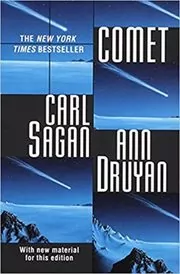
Comet
by Carl Sagan
1985
Comet follows these icy wanderers from ancient omens to modern science. Sagan and Ann Druyan explain what comets are made of, how they move, and how encounters with them have shaped planets, inspired myths, and occasionally threatened Earth.
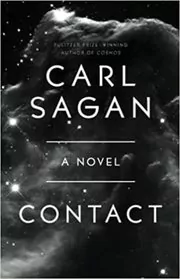
Contact
by Carl Sagan
1985
Contact follows radio astronomer Ellie Arroway, who helps detect a message from an alien civilization. As nations struggle over how to respond and whether to build a mysterious machine, Ellie wrestles with politics, faith, and what genuine contact might mean.
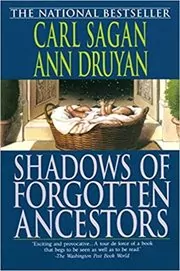
Shadows of Forgotten Ancestors
by Carl Sagan
1992
Shadows of Forgotten Ancestors, written with Ann Druyan, traces the evolution of life from single cells to modern humans. By comparing us with other animals, the book probes the biological roots of traits like violence, love, language, and morality.
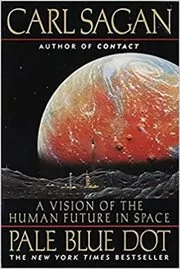
Pale Blue Dot
by Carl Sagan
1994
Pale Blue Dot looks outward from the famous photograph of Earth as a tiny speck in space. Sagan recounts the story of planetary exploration and argues that seeing our world from afar changes how we think about war, ecology, and our shared future.
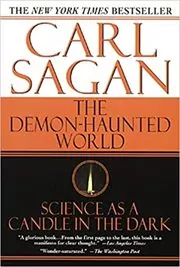
The Demon-Haunted World
by Carl Sagan
1995
The Demon-Haunted World is Sagan’s plainspoken defense of science and critical thinking. Using examples from UFO claims to faith healing, he shows how skepticism and a simple “baloney detection kit” can help us tell the difference between evidence and comforting illusion.
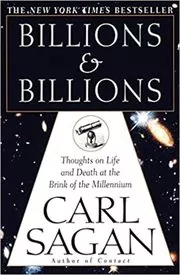
Billions & Billions
by Carl Sagan
1997
Billions & Billions gathers Sagan’s later essays on science, the environment, and public life. Written during his final illness, the pieces range from climate change and planetary ethics to personal reflections on mortality and what it means to leave a livable world behind.
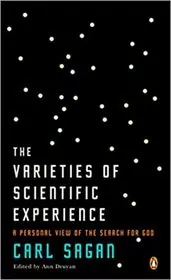
The Varieties of Scientific Experience
by Carl Sagan
2006
The Varieties of Scientific Experience presents Sagan’s talks on science and religion, adapted from his Gifford Lectures. He examines ideas about God, the origin of the universe, and meaning in a vast cosmos, inviting readers to see awe through a scientific lens.
Where to start with Carl Sagan
If you want his big-picture tour of the universe: Cosmos → Pale Blue Dot
If you're interested in science and critical thinking: The Demon-Haunted World → Broca's Brain
If you want to explore human origins and evolution: Shadows of Forgotten Ancestors → The Dragons of Eden
If you prefer science fiction with real science roots: Contact
If you want late-career reflections and essays: Billions & Billions → The Varieties of Scientific Experience
Carl Sagan collections, short stories, and related book types
Non-Fiction
Standalone Carl Sagan books
Author bio
Carl Sagan was a planetary scientist, astronomer, and storyteller who made the cosmos feel like a neighbor rather than an abstraction. Born in Brooklyn, New York, in 1934, he grew up in a working‑class family that encouraged his curiosity, from comic‑book rockets to long afternoons in the public library reading about stars and ancient civilizations.
As a teenager he was already writing letters to observatories, trying to understand what life might look like on other worlds.
That fascination carried him to the University of Chicago, where he raced through undergraduate and graduate work in physics, astronomy, and astrophysics. There he began to ask the questions that would guide his career: how planets form, how atmospheres behave, and whether biology is a common outcome of cosmic chemistry.
After early research posts, Sagan joined the faculty at Cornell University, where he became a leading voice in planetary science. He worked on missions to Mars, Venus, Jupiter, and Saturn, helping interpret the data from spacecraft and showing how greenhouse effects, dust storms, and organic hazes could shape alien worlds.
He also had a hand in humanity’s first messages to possible extraterrestrial neighbors. Sagan helped design the Pioneer plaque and led the team that created the Voyager Golden Record, a time capsule of sounds and images meant to introduce Earth to whatever might someday find our spacecraft.
Alongside the research, Sagan wrote for a wide public. His television series Cosmos: A Personal Voyage and the companion book Cosmos brought the history of science, from ancient Greece to modern rockets, to living rooms around the world and showed that astronomy could be emotional as well as technical.
In books such as The Dragons of Eden, Contact, Pale Blue Dot, and The Demon-Haunted World, he moved easily between hard data and big questions. He wrote about the evolution of intelligence, the search for life beyond Earth, the ethics of exploring other planets, and the need for clear thinking in an age crowded with superstition and hype.
Again and again, he came back to the idea that science is not a cold set of facts but a way of not fooling ourselves.
Sagan’s public work often blurred into activism. He spoke out about the risks of nuclear war, helped develop early "nuclear winter" models, and argued that looking back at our fragile planet from space should make us more cautious and more compassionate. He picked up major science, writing, and television awards along the way, but he treated them mostly as tools to reach a wider audience.
In his later years he taught, wrote, and collaborated closely with producer and writer Ann Druyan, his third wife and frequent coauthor. Sagan died in 1996, but his voice still turns up in classrooms, planetariums, and the memories of readers who first met the universe through his pages. His work continues to nudge people toward curiosity, humility, and a sense that we share a small, luminous world in a very large dark.









Edited by
Software engineer whose passion for tracking book recommendations from podcasts inspired the creation of MRB.
Lead investor at 3one4 Capital whose startup expertise and love for books helped shape MRB and its growth.
Comments
Did we miss something? Have feedback?
Help us improve this page by sharing your thoughts